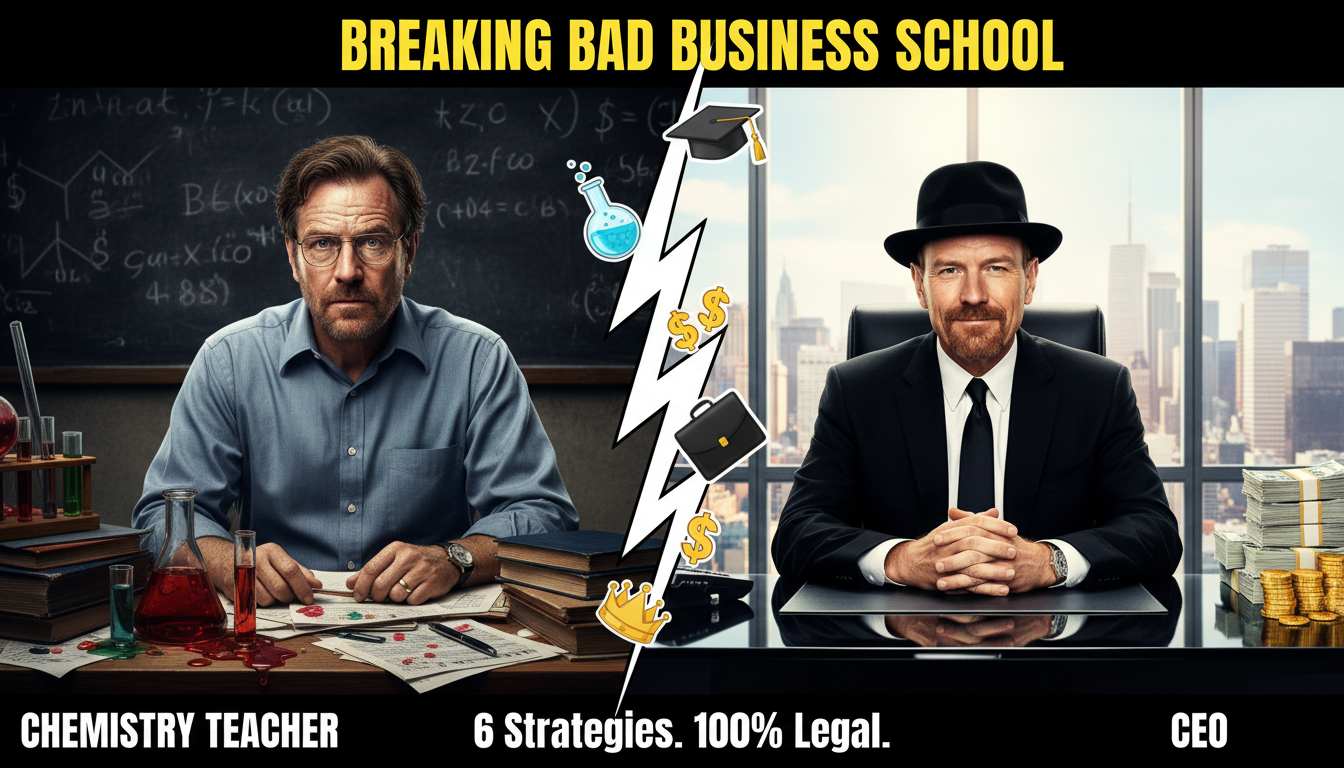
Breaking Bad Business School: 6 Walter White Strategies — The Legal Version
Walter Hartwell White. High school chemistry teacher. Terminal cancer patient. And the founder of a vertically integrated enterprise generating an estimated $80 million in annual revenue, distributed across three states, with a brand so powerful that customers refused substitutes even when supply ran dry.
He was also a murderer and a deeply broken human being — we are not endorsing those parts. But strip away the felonies and what you have is one of the most ruthless business operators in television history. Here are 6 of his core strategies, translated into something you can use Monday morning. Say my name.
Hack 1: The Blue Sky Differentiator — Make Your Product So Good Comparison Becomes Embarrassing
Walt’s product had 99.1% purity. Every competitor operated in the 60–70% range. Customers asked for it by color. Distributors fought over access. Price was never the conversation. This is product differentiation so extreme that comparison shopping becomes impossible — not 10% better, not improved formula, categorically and visibly superior.
- Find your purity metric: Speed, support depth, output accuracy — pick one dimension and go to the extreme.
- Make it visible: Blue Sky was literally blue. Your differentiation must be immediately perceivable.
- Price accordingly: Walt never discounted. Premium product commands premium pricing. Full stop.
Pro Tip: The best brands make price comparison feel embarrassing. That is the target.
Hack 2: The Heisenberg Pivot — Reinvent Before the Market Does It For You
Walter White the teacher was invisible, underpaid, and dying. Heisenberg was a brand. Same person, completely different market position — and he committed fully. Every business eventually faces a moment where its original identity stops working. The companies that survive reinvent deliberately rather than waiting to be disrupted.
- Audit your identity: How do customers describe you today? Is that still where you want to be?
- Name the new version: Heisenberg had a name. Your pivot needs one too.
- Commit completely: The half-pivot is worse than no pivot at all.
Pro Tip: Pivot before you need to — when you still control the timing.
Hack 3: The Jesse Pinkman Partnership — Find the Operator to Your Visionary
Walt had the product. Jesse had the street-level distribution knowledge and the customer relationships. Neither could scale alone. The Visionary-Operator combination is the most consistent pattern in successful founding teams — Wozniak and Jobs, Gates and Ballmer, Bezos and Wilke. The person with the breakthrough idea almost never has the operational DNA to scale it.
- Be honest about which one you are. Most founders think they are both. Most are wrong.
- Hire your exact opposite: If you build, find someone who sells. If you sell, find someone who builds.
- Formalize it early: Titles, equity, decision rights. Walt and Jesse’s undocumented arrangement nearly destroyed everything repeatedly.
Pro Tip: The best co-founder makes you slightly uncomfortable because they are so good at what you are bad at.
Hack 4: The Distribution Deal — Own the Channel, Not Just the Product
Gus Fring had an inferior product and more power than Walt. Because Gus owned the channel. Distribution beats product — every time, in every industry. Edison beat Tesla. McDonald’s beats better burgers daily. Amazon beats better retailers. The company that owns how the product reaches the customer holds the ultimate leverage in any value chain.
- Map every distribution path: Direct, reseller, marketplace, partnership. Know all routes.
- Own at least one channel completely: Email list, direct sales, owned retail. Something no platform can revoke.
- Never be 100% dependent on one distributor: Walt’s dependence on Gus nearly got him killed. Literally.
Pro Tip: Build distribution before you need it. The worst time to negotiate terms is when you have no alternatives.
Hack 5: The Methylamine Supply — Secure Critical Inputs Before You Scale
The scariest moment in Breaking Bad is not any confrontation. It is when the methylamine gets cut off. Best product on the market, strongest distribution, most sophisticated operation — and suddenly, nothing. The whole empire hostage to one uncontrolled input. Every scaling business has a methylamine. Most founders only discover theirs after it disappears.
- Audit your critical dependencies: What supplier, platform, API, or hire could shut you down in 30 days if it vanished?
- Build redundancy before crisis: Second supplier qualified, alternative platform tested, cross-trained team member ready.
- Pay the premium for supply security: The margin hit is always smaller than an operational failure.
Pro Tip: Your most dangerous dependencies are the ones that have never failed — because you have never had to think about them.
Hack 6: The Exit Problem — Know When the Empire Is Finished
Walt could have stopped after Season 2. More money than his family needed. Cancer in remission. He kept going — not because the business needed him, but because he needed the business. By the time he admitted it, everything was gone. The most expensive mistake in business is not starting too late. It is not knowing when you are done.
- Define your enough before you start: Revenue, customers, market position — write it down before success moves the goalposts.
- Build it to run without you: If it cannot, you have built a job with higher stakes, not a business.
- Know the difference: Staying because it is right versus staying because you are afraid to leave. One is strategy. The other is what happened to Walter White.
Pro Tip: The best exit is the one you chose. Not the one forced on you.
Final Boss: The Real Lesson
Walter White built one of the most operationally sophisticated enterprises in television history — then destroyed it because he confused the business with himself. The six hacks above are real. The warning built into each of them is equally real. Build the empire. Just do not become it.
More unfair advantage playbooks every week at Supabizhack — where the best business lessons come from the most unlikely classrooms.